Fentastic Fungi Finds

Fentastic Fungi Finds

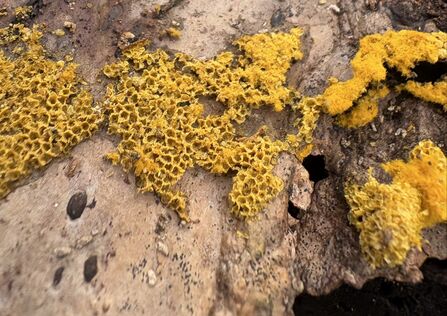
Crimped gill (Plicatura crispa). Credit - Sarah Lambert 

One National Nature Reserve. Three new Peatland Progress trainees. Up to 500 fungi species to find! Luckily, Ellen, Katie and Kaitlyn were working with Sarah Lambert on our new guided walk for young people, supported by the National Lottery Heritage Fund. Read all about their favourite finds...

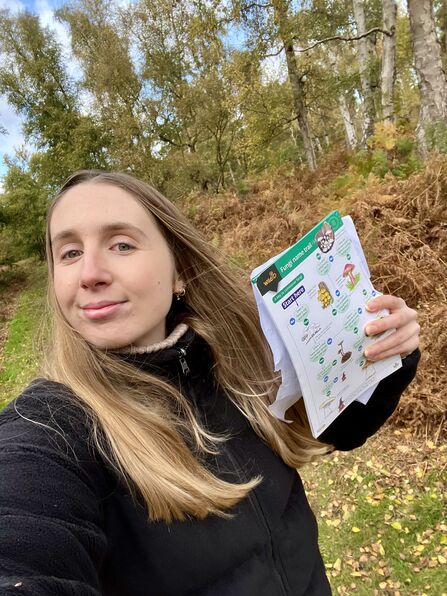
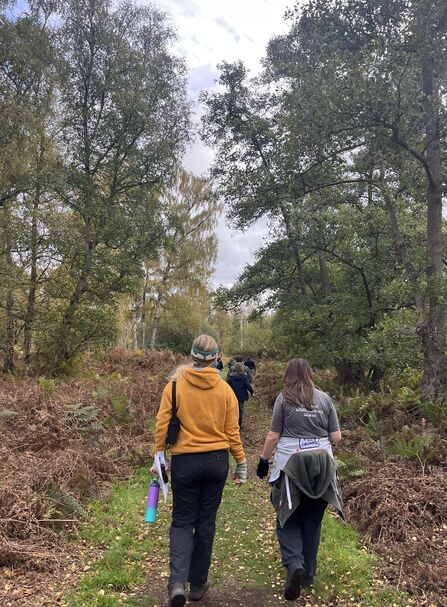
Last week, we were lucky enough to join a group of young people (aged 13-24) at Holme Fen National Nature Reserve. We were assisting a new guided walk led by Sarah Lambert. Sarah is a professional botanist, ecologist and fungi enthusiast with a huge breadth of knowledge, so we couldn’t wait to hear what she would share. As well as seeing the beauty of the site for the first time, we were going to learn all about the fungi found there and their role within our local habitats.

Holme Fen is a Site of Special Scientific Interest (SSSI) which means it’s protected because of its incredible biodiversity. It’s also part of the Peatland Progress project. This is the exciting plan to connect Holme Fen to Woodwalton Fen as part of a vast Living Landscape. Did you know, over 500 species of fungi have been recorded at Holme Fen? Fortunately, Sarah was the perfect guide. She gave us a comprehensive list of the species we’d be most likely to find here and taught us how to identify them.
What Are Fungi? 

Picture some fungi in your mind. Are you imagining a captivating red toadstool? Many do! Fungi like these have appeared in traditional fairy tales and folklore for generations. That shapes the way we think about these fascinating organisms. The relation to mythical creatures and childhood stories has even influenced their names. Fairy Rings were believed to be formed by faeries dancing through the woods. There would be dire consequences for any human that entered that magical circle! In reality, they’re made by an underground fungi network that forms a circle of mushrooms when fruiting. Still fascinating!

For hundreds of years, fungi were considered plants. Now we know that fungi are very different and belong to their own kingdom altogether. They either live underground or on a host, with their living body hidden from view. This is called the mycelium and is made up of a tiny branching network of threads known as hyphae. What we see above ground are their fruiting bodies, such as mushrooms. These contain spores, which are dispersed for reproduction. Fungi get their energy by absorbing nutrients from the organic material that they are growing on. This is usually leaf litter, rotting wood or decaying organisms.

What’s in a name?

Sarah’s list included dramatic names such as smouldering webcap, the deceiver and blushing bracket. Some names bring breakfast buffets to mind: honey fungus, buttercap, milkcaps. Some would put you off your lunch: yellowing curtain-crust, jelly rot, bolete mould, blistered cup. We learned that gills come brittle, crimped and pink. Bonnets can be rosy, lilac, steely and nitrous. Caps, cups, funnels and webs, balls and brackets… there’s so much to discover!

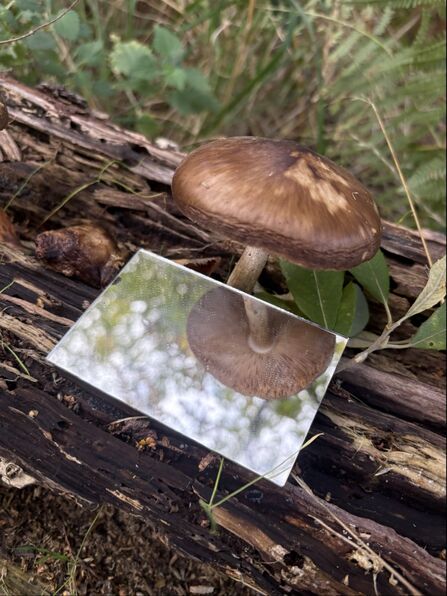
We moved like snails, scanning every inch of deadwood in a large log pile or gnarled tree stump, hoping to spot tiny colourful jellydiscs or mosscaps. It was an incredible lesson in observation, patience and care. 

Our favourite finds

Although you can find fungi at any time of year, autumn is a particularly good season to go looking. The damp conditions and decaying leaf litter breed the ideal habitat for fungi to grow. Even though it’s been unseasonably dry recently, we did find 45 different species of fungi on just this one walk! We spotted our first species after only 100 metres. 

A blue-green fungi growing in autumnal birch leaves on the ground

Aniseed funnel (Clitocybe odora)

Aniseed funnel (Clitocybe ordora). 

This blue-green mushroom has a strong, distinctive smell of aniseed. It is often dried and ground up to be used as seasoning in food. (Please remember, foraging is illegal at Holme Fen).

The cap of the aniseed funnel starts out curved, before flattening and become funnelled with wavy edges. 

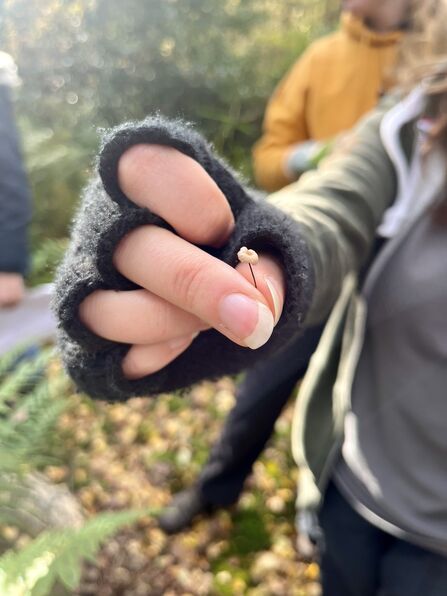
Kaitlyn holds an aniseed fungi up to smell it

Smelling the aniseed funnel fungi. (Please note, no fungi were removed and permission was sought before conducting these investigations).

Fungi can have many surprising uses, like the glistening inkcap. 

Cluster of small brown mushrooms growing in birch leaf litter. They have a white powdery coating

Glistening inkcap (Coprinellus micaceus).

Glistening inkcap (Coprinellus micaceus)

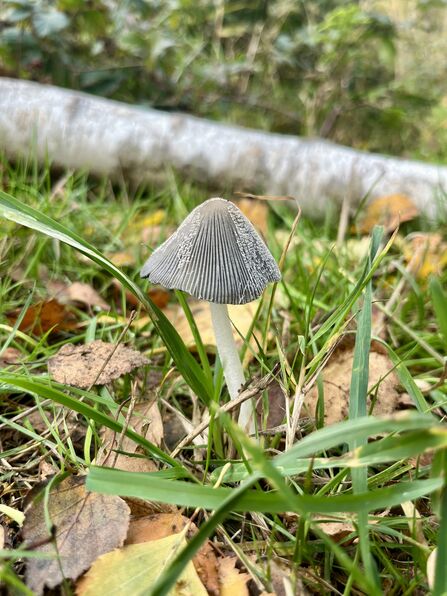
A dome-shaped fungus that grows in clusters. They are covered in a fine powder (mica) that makes them glisten in the sun. 

As they mature, they deliquesce, melting into a black inky liquid. Historically, inkcaps were used to make ink, hence their name.

Lots of the fungi we found have unique features. As beginners, this certainly made it a bit easier to identify them.
Hoof bracket fungus growing on tree trunk

Hoof fungus (Fomes fomentarius)

Hoof Fungus (Fomes fomentarius).

A tough polypor found on birch trees. 'Polypor' means that the inside of the fungus is full of tiny tubes which then form many minuscule pores that visibly cover the underside. Each year, it grows a new layer and increases thickness, making it look like a hoof.

Bracket fungi like this are incredibly important for other wildlife. Beetles, fly and moth larvae consume them, with some developing inside them. 

Hand holding a hoof fungus showing the tiny tubes internally that form the pores on the outside

Hoof fungus cross-section

A cluster of yellow fungi growing out from moss on a fallen log

Sulpher tuft (Hypholoma fascuculare)

Sulphur Tuft (Hypholoma fascuculare).

Grows in clusters on tree stumps, producing mushrooms in bright sulphur-yellow colours. Their dark spores make them a great fungus for spore printing. They are also bioluminescent, so they glow under UV light!

Like many of the other saprotrophic species, it is essential in the ecosystem for breaking down dead wood and recycling the nutrients. 

You may have regularly seen some fungi without realising what it was.

Green bramble leaves with red-purple spots

Violet bramble rust (Phragmidium violaceum)

Violet Bramble Rust (Phragmidium violaceum).

A type of gall-causing rust fungus that attacks bramble. It is visible on leaf surfaces as bright pink-purple spots. Underneath, you see the individual uredinium. These are black spot-like masses formed when the fungi burst through the leaf surface. The good news is that the berries continue to ripen and are safe to consume.

Black spots on the underside of a green bramble leaf, held between fingers

Violet bramble rust

We were thrilled to end our walk with a particularly magical find. Perhaps, the one you imagined at the start? The classic fairy-tale toadstool.

A red capped mushroom with white stem and white spots growing in birch leaf litter

Fly agaric (Amanita muscaria).

Fly Agaric (Amanita muscaria). 

Characterised by its bright red cap and white stalk, the cap is often scattered with white ‘spots’. These are remnants of the tissue veils that first covered the young mushroom. 

Fly agaric was traditionally used to attract and kill flies – hence the name. 

Although we can’t eat it, being poisonous, it is enjoyed by slugs and fly larvae, highlighting its value in the wider food web.

Closeup of an old fly agaric mushroom, red cap nibbled and wide white gills showing

Fly agaric is enjoyed by slugs and fly larvae

I spent a wonderful morning with this group of very enthusiastic young conservationists. Experiences like this give young people the chance to connect directly with wild places and develop a deeper appreciation of habitat complexity. Most importantly, while learning, we had a lot of fun together!
Sarah Lambert - Event leader
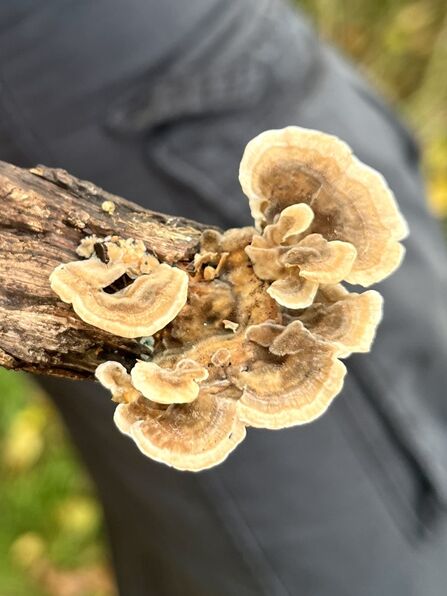
A large cluster of small shell-shaped fungi growing from a silver birch log

Crimped gill (Plicatura crispa). Credit - Sarah Lambert 

Crimped gill (Plicatura crispa)

Sarah said, "My personal favourite was Crimped Gill: row upon row of toasted-marshmallow-like shells covering a fallen Silver Birch trunk—a relatively new arrival to our area."

Future Events: 

These are just some of our favourite species seen on the day. We’re keen to return and look for more, having learned so much from Sarah about the world of mycology. The guided walk was a great experience for all the attendees. They met others with similar interests, and it introduced them to new local wildlife. Everyone left with interesting fungi guides, knowledge of different wildlife found in the Great Fen, and new friends.  

More amazing sessions can be delivered, thanks to the National Lottery Heritage Fund. That means Peatland Progress reaches more young people and connects them with nature. These events are open to anyone, no matter how much knowledge you have. If you want to pursue a career within this sector, or simply enjoy being outdoors, keep a look out for future events

A note before heading off on your own fungi foray - Under the Wildlife and Countryside Act 1981 (as amended) it is an offence to forage on a SSSI. At Holme Fen, you require the consent of Natural England for any collecting, whether for personal or scientific reasons. 

Read these top tips from the British Mycological Society regarding responsible behaviour. 

Remember to record and share your sightings, wherever you go. If you're in the Great Fen, we'd love to receive your findings too. Here's a link to The Fungal Records Database of Britain and Ireland and the iNaturalist app. 

Have fun!