
Although we are based with the Community & Education team at Ramsey Heights, as Peatland Progress trainees, we aren’t just restricted to the office. We sometimes find ourselves venturing out into the wild, undertaking loads of different tasks and learning key conservation skills. From building post-and-rail fences to scrub bashing, we have worked alongside various rangers on different reserves across Beds, Cambs and Northants. Here are some highlights of my time surveying at home base- The Great Fen.
Trainees out in the wild

Trainees walking through a wet Great Fen
Peatland Progress trainees head out into the Great Fen to develop their skills as ecologists and conservation rangers!

Trainees walking through a wet Great Fen
In January, I joined Henry Stanier (Great Fen Monitoring & Research Officer) to assist in my first ever bird survey! I wasn’t sure what to expect and was a little nervous. I'm still learning about birds (I only started last year!) so was worried I wouldn’t be able to identify anything and would embarrass myself. Fellow trainee Katie and I turned up at the location early morning, geared up with wellies, binoculars and clipboards. Looking at the map of our route, it was a lot longer than expected and very daunting. Then, once everyone was ready, we followed Henry to our first field.
We walked through each field in a zigzag direction, encountering a lot of different species, thankfully many that I know and was confidently able to identify, and some new species I was able to learn. I’ve always struggled to identify if this small brown bird flying up and singing was a skylark or meadow pipit, but after the day, I finally figured out which is which, understanding the different morphologies, behaviours, and songs!
We were out in dry, grassy fields during the first half. An audience of Aberdeen Angus stared at us, wondering why three silly humans were out walking in circles in their fields. At one point, a small group of juveniles followed us as we walked by their fence, stalking us... I couldn’t tell if it was adorable or scary!

Kaitlyn in the middle of a wet Great Fen farm
But, by the second half of the survey, we were in fields that looked like the stereotypical wetlands. Full of rushes, reeds, sedges, Typha, and lots of water. Wading around in the water, trying to zigzag through all the vegetation, water almost up to our knees threatening to fall into your wellies, and your feet getting stuck in the peaty soils was definitely an experience. Apart from almost falling face first into the eggy smelling water (hydrogen sulfide gas released from the decomposition of organic materials in oxygen-deprived, waterlogged conditions), it was actually really fun. We were accommodated by the sun finally breaking out of the clouds for a short period, and the view was gorgeous. So gorgeous I ended up painting it as soon as I got home!
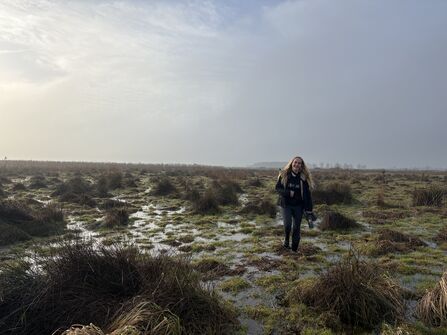
Katie during a bird survey in the Great Fen
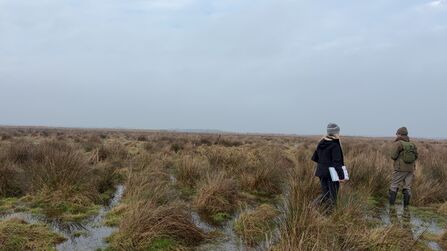
Katie and Henry during a bird survey in the Great Fen

Sunshine over wet meadow by Kaitlyn Goodwin
A week later, all three of us trainees were back out in the fens for another survey. But this time it was about what’s under our feet! As the Great Fen is part of FEPP (Fens East Peat Partnership), we were able to shadow Matt Quinn and Sophie Bowers of the Lincolnshire Wildlife Trust Fens East Peat Partnership as they conducted a soil survey at New Decoy. The difference in the weather was very drastic- cold, windy, rainy, icy…a typical British day. And because we are in the fens, with large stretches of flat lands all around you and no barriers, we felt these icy easterly winds go straight through to our bones. Bundled up so much where we couldn’t move easily was no barrier to the wind!
Although the weather wasn’t playing nice, it was amazing to see the progress at New Decoy, with the new ditches full of water, starting to look like a wetland. I even saw a little egret moving in, paddling around in the water next to a digger! The next day when I was back at New Decoy leading my own Youth Ranger session, the sun was so bright, and the ditches looked sparkling blue and so beautiful.

Katie using the Auger to put soils samples into the empty half drain pipe
Back to the surveying! I’ve never done a soil survey before, so this was all new to me. In order to conduct the soil survey, a hand soil combination auger was used to remove sections of the soil horizon in 10cm increments down to a depth of 100cm. We then laid these samples in order into a half drain pipe to recreate the 100cm soil horizon from the surface. I really underestimated the amount of strength you needed to break the surface of the soil- at first, I wasn’t putting nearly enough power behind the auger, and it kept going around and around at the top, not even making a dent.

Kaitlyn trying to examine the different soil samples in the half drain pipe with the aid of Sophie Bowers
Once the soil was laid out into the half drain pipe, it was time for the trickier bit. Using a soil texture chart and Von Post humification scale, we had to categorize the soils by their texture and humification (the process of decomposition to create dark earth/humus). There was a chart with different descriptions to use, but it took a little time for me to understand. For example, the difference between H5 and H6 on the Von Post scale seemed to be so similar! I just sat there squishing the soil so many times and trying to feel the differences between all the classifications. It was really interesting to see some samples that had small bits of bog oak or preserved pieces of reed, probably thousands of years old!
After we were done, they showed us how they survey the land using drones with different features such as infrared cameras. Matt is currently researching his own concept for using the thermal drone to detect peat. The hypothesis is that peat may hold differing temperatures to mineral soils through the different seasons, so you could identify peat at key times of the year with the drone! My mind is blown. I'm excited to see the potential use of this in the future.
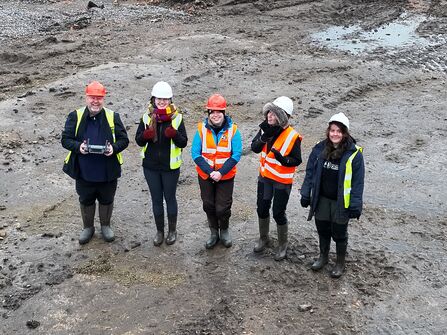
Group selfie on the drone camera
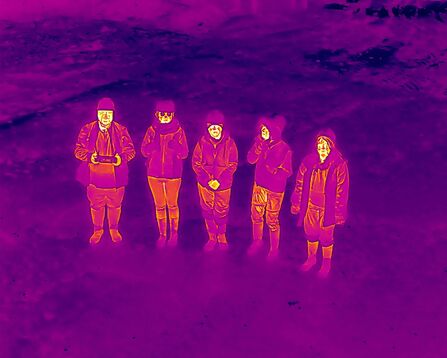
Infra-red picture of the Lincolnshire Wildlife Trust and Peatland Progress
Over the course of this traineeship, we’ve been able to sharpen our surveying skills through surveying soils, birds, ponds, and protected species. We’ve planted, laid, coppiced, and popped trees. We built various fences for grazed cattle, mended a boardwalk for the public and bashed scrub. Throughout all of this, we were able to strengthen existing and new identification skills, learning how to identify wintering trees, tracking trails and footprints, different types of fungi and more. All of us will be leaving with valuable skills, knowledge, and confidence in not only conservation skills but a variety of soft skills too. Equipped with this experience, we feel confidently prepared to tackle what comes after the traineeship. I can’t wait to see what’s next!

National Lottery Heritage Fund Logo
Peatland Progress traineeships are made possible thanks to the National Lottery Heritage Fund.


