
Since retiring I have enjoyed being able to spend time volunteering for Natural England at the Great Fen. Recently I have been fencing, which is too much like hard work, but it is essential to manage the grassland for grazing animals.
Retirement works for wildlife at home and in the Fen

Catherine's garden has never worked better for wildlife than since retirement!
Since retirement, Catherine Weightman has been balancing her time between working for wildlife in the Great Fen and the wildlife at home, in her award-winning garden!

Catherine has been volunteering with fence maintenance work in the Fen.
This Spring, however, I did need to spend time in my large town wildlife garden. I was proud to receive the gardening award from the Wildlife Trust for Beds, Cambs and Northants, as my garden meets the criteria, having three ponds and a diversity of habitats.
If truth be told, what I like doing best in my garden is sitting and looking at it! Over the years, we have recorded 69 bird species, including a kingfisher on several occasions. We have definitely heeded RSPB advice over the last few years and changed our bird feeding habits; no flat table and limited summer feeding, except for fat blocks. In the past, we had large bird feeders, which were difficult to clean. Now, we have several smaller bird feeders, which we can wash in the sink, every time we fill up.
I was inspired by our recent trip to Panama when we visited our bird guide's hummingbird feeders. They really considered how to set up feeding stations for photographers. I like watching our blue, great, coal and long-tailed tits on the feeders. We have tried to make sure the feeders are out of reach for cats and squirrels. I was so pleased to see in the recent BBC Secret Garden series, David Attenborough speaking out about how many birds that cats in the UK kill: approx. 55million birds! I wish our neighbours cats had bells, or better still they kept them indoors.
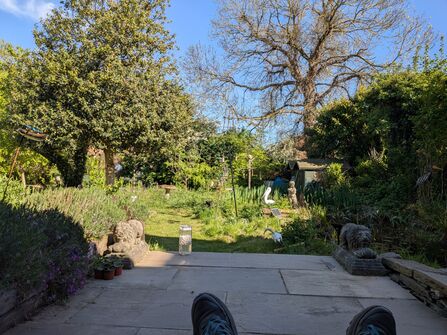
Catherine most enjoys sitting and watching her garden grow.
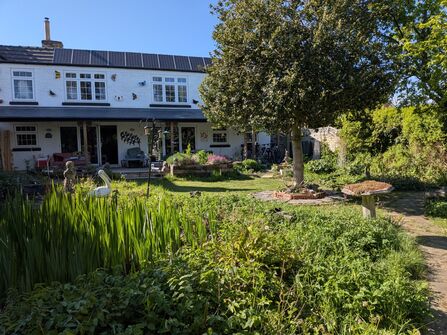
Catherine's garden has never worked better for wildlife than since retirement!
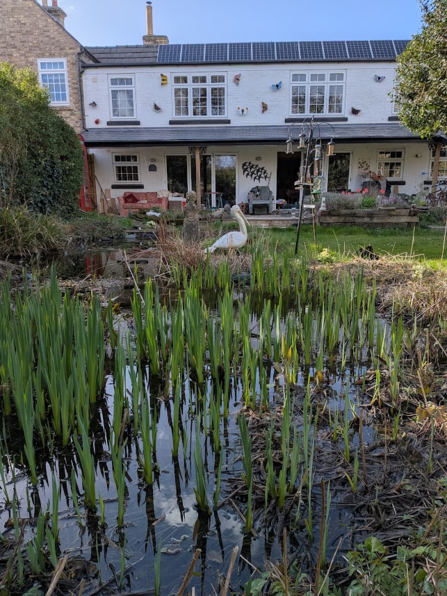
One of Catherine's three ponds
My favourite garden bird must be a robin. I have a large compost area and each time I am in the garden I turn over compost to allow the robins to feast on woodlice etc.
I am certainly not a tidy gardener. I just think about what wildlife I can attract by having a wide variety of native and insect-friendly plants. I don’t buy plants from garden centres but grow from seed and scrounge plants from friends and relatives’ gardens. The last time I moved house, my major worry was moving my pond plants.
Fortunately, we did not move far and were able to dig a new pond soon after moving house. I do lose plants. Some plants, such as ox-eye daisy and alkanet are keen to take over, but I must be doing something right as we have had at least 250 different moths in the garden!

Not a tidy gardener, the wilderness and compost heap in Catherine's garden works wonders for wildlife.
After some time tending to my wild patch, I'm ready to head back to the Fen to care for theirs. This week, litter picking at Holme Fen NNR. For me it is good to have a balance of trying to do my bit for wildlife in my garden and volunteering at the Great Fen.

Catherine balances her time between helping wildlife at home and with fellow volunteers in Holme Fen.

A wildlife-friendly feature such as a log pile is an excellent addition to your garden.
Wildlife Gardening Award Scheme
Is your garden wonderfully wild? Enter it for an award!